


DREF Anticipatory Pillar
15 September 2026
The International Federation of Red Cross and Red Crescent Societies (IFRC) and the Netherlands Red Cross are joining forces to accelerate anticipatory action globally. By 2030, our aim is for at least 30 National Societies to use the new National Risk Watch to continuously monitor around 50 hazards and act ahead of impact. This new service will be made available through IFRC’s GO Platform. Building on a National Risk Watch pilot led by the Malawi Red Cross Society, this collaboration between key anticipatory action partners is the next step in building a shared system for anticipatory action across the Red Cross Red Crescent Movement.
National Risk Watch turns forecasts into decisions and decisions into early actions. It provides National Societies, government counterparts and community actors with a single, intuitive workspace to (1) monitor risk in near real time, (2) understand who and what may be affected, and (3) trigger pre-agreed actions, well before a hazard becomes a disaster. The platform brings together hazard forecasts, exposure and vulnerability information, and operational context so users can act on time, every time.
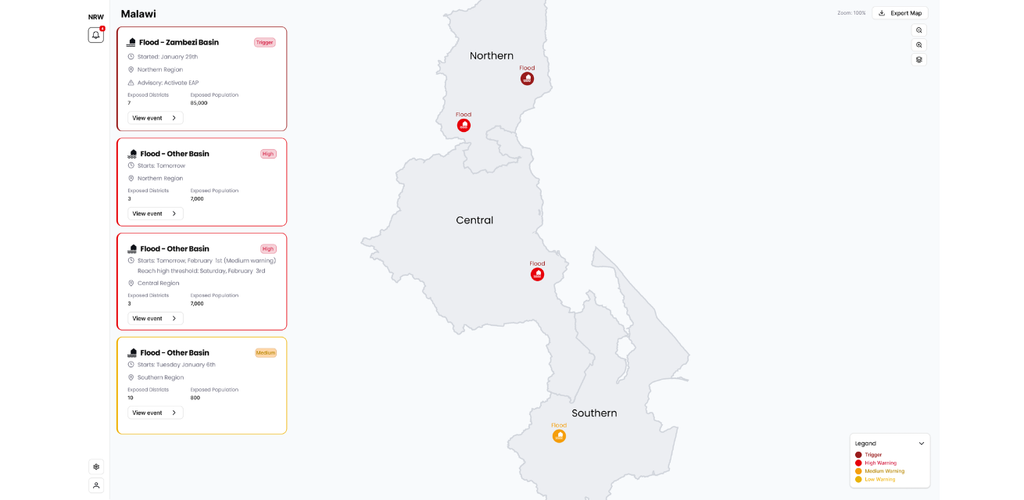
National Risk Watch will adopt IFRC GO’s user log-in, design system and navigation, so users experience a consistent look & feel and can move seamlessly between GO’s preparedness, risk, and operations modules. On the back end, the platform will integrate with Montandon, a global crisis data bank which provides the core historical and forecast disaster data commons for the humanitarian sector. This allows countries to contextualize today’s risk against decades of recorded impacts while enabling impact models to improve as new data becomes available.
National Risk Watch is a co-developed service which will be managed by the Netherlands Red Cross in close collaboration with IFRC and anticipatory action partners. The roadmap is jointly guided to ensure the platform supports Movement-wide priorities such as Early Warnings for All, integration with government systems and the localization of anticipatory action. This model lets us pair the Netherlands Red Cross’ product experience with IFRC’s global coordination role and GO’s mature web infrastructure, avoiding parallel systems and accelerating scale across regions.